This week has been quite tiring I hadn’t really appreciated how many things you have to do as a teacher here! And the heat in the afternoon can make it hard to gather the effort to do things but it is possible. The week started with the assembly in the school hall again with the national anthem and a lot of notices about the term ahead. There were many more students this time than there were last week probably around 3 times the amount! There should be around 600 by now I have been told which is the capacity of the school.
The school was built in 1991 as a partnership with the Japanese government to help Zambia develop so they donated the school to the Zambians. Due to a lack of money these buildings are much the same as they were when they were built. One thing I have noticed about teaching in the classrooms is the heat as the sun gets stronger throughout the day. Despite having windows all along the classroom which are almost permanently open, the heat radiates from the roof. It is made of black corrugated panels. They aren’t iron but they still absorb lots of the heat from the sun and radiate it into the classroom. This can make it very hot despite the breeze it feels a little like you are putting yourself under a gentle grill when you enter a class room sometimes around lunch time.
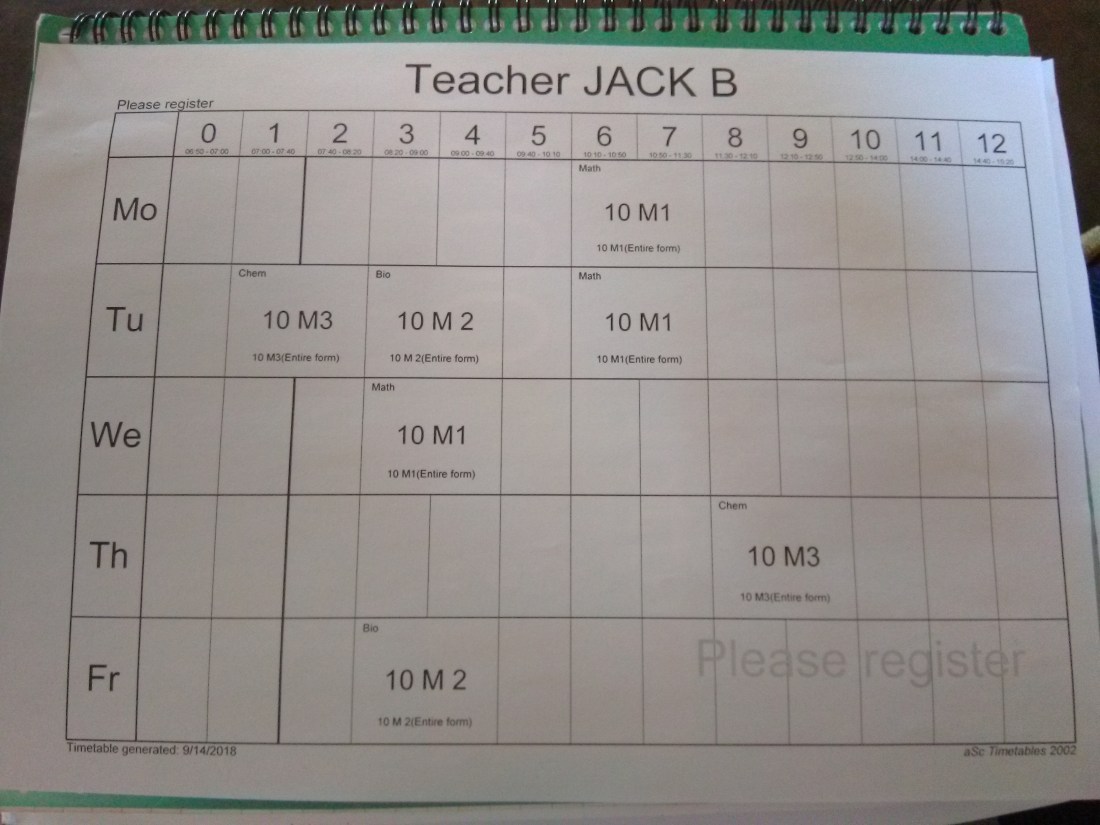
I received my new timetable at the start of this week. I have three classes a maths class for grade 10 (Year 11) which I teach for 6 periods a week. A period is 40 minutes but they are always in sets of two so 1 hour 20 minutes. I have my grade 10 chemistry and biology classes for two double periods a week each. I have a very busy day on Tuesday teaching all my classes back to back. The school day starts at 7am each day and most lessons are done by around 12:50 when we have lunch although I have run a few classes after this to try and fill some gaps or provide the students with extra help with understanding classwork.
Andrew and I had to make our first test this week and it is for all four grade ten classes. We were told to make it based on the first and second term’s work as well as what we have covered this term so far. We were meant to be creating it alongside another teacher however she couldn’t arrange child care for the day so we had to do it alone. It feels like a huge responsibility and not something we have ever done before. We found the schemes of work for the previous terms and chose some topics to create questions for. We used a range of resources including modifying text book questions, past papers from the uk and practice questions we found online. We have now received confirmation from the head of maths that it’s suitable which is good to hear. Now we just have to make the marking scheme. We wanted to check last year’s test to see if it was similar however the office where it is kept was locked since many staff were away at a funeral that day.
Some of my lessons have had to be taught outside. This is because of a shortage of classrooms for the pupils. Normally there are enough however last term one of the dormitory blocks caught fire; no one was hurt but the building is unusable. So the students are now sleeping in what used to be classrooms that have been converted to dorms. But this has lead to a lack of classrooms. Teaching outside is nice though as it’s done under a tree in the shade and it is often a lot cooler than in the classrooms. The only problem is the board space is limited since you only have one portable board that is about the width and height of two single school desks and they are propped up against the tree sometimes balanced on chairs or tables. Since this is about four or five times smaller than the normal classroom width chalk boards it can be a challenge as you have to make sure the students have finished copying as you have to rub off the board regularly to write new things.
There is also the problem of the animals the chickens this time are not the culprits. It is the cows there seems to be a heard of cows, including a couple of bulls, which live around here. I haven’t yet established if they belong to the school or just a local farmer. Whether they belong to the school or not they are often found being walked through the school grounds by a man with a stick. When teaching in a classroom this is not a problem however when you are outside they can get pretty close. The students often have to leave their seats, quite sensibly, in case the cows come closer and start charging. They don’t tend to get too close although one of the cows has three claves and the other day one got lost and started mooing and the mother came charging to find it causing the pupils to have to run away. Fortunately this wasn’t during a lesson the kids were just milling about during break time.
One of Andrew’s and my favourite times of the day is break time. As teachers we get a snack and drink provided to us. One of the home economics teachers makes these muffin/scone type snacks freshly each day. They are always deliciously warm and soft as well as being just sweet enough to be satisfying but not sickly. There is also a cordial, usually pineapple for a drink which is very refreshing. We want to learn how to cook what we call muffins, due to their shape. However the staff call them scones but I think they are more like a muffin inside really. So one morning we will go and watch them make them and get the recipe so we can make them at home as we could both eat at least two in one go but we can only have one in the staff room.
Teaching can be quite challenging as despite having a standard UK accent the children seem to struggle to understand what we are saying, as we do with them at times. I have had to slow down what I am saying in order to make sure that everyone has a chance of understanding what I am trying to explain. I have found this hard especially if I am trying to explain a problem as I often get faster when I am enjoying solving a problem. I have also started using fewer long or complex words and instead using more common ones as this makes it easier for them to understand. The reason many children struggle to understand is perhaps due to a lower standard of English generally. Since for many English is a language only spoken at school as a second language they struggle to form coherent sentences and understand complex English. This is totally understandable since if the language you speak at home is Chinyanja then why would you speak English there? It is unlikely that their parents would speak any English at all especially if they live in a rural village.
I hope that gives you a bit of an insight into the school and the way it works. In another blog post I will describe how the school is set up a little more including more pictures of the school.

 Jack in Zambia
Fascinating Jack- you write really well. I can picture it so clearly.
LikeLike
Thanks Helen! I’m glad you enjoy reading it.
LikeLike